Image illustrative (photo de stock) ; ce n'est pas le produit exact.
Battery Life Changes What A Smartwatch Is
A smartwatch charged nightly is a device you take off every day, which means it cannot track sleep reliably and it is not there when you reach for it in the morning.
The Instinct 2 runs for weeks rather than days, and with adequate sun exposure the solar charging can extend that to a point where in normal use it barely needs a cable at all.
That changes the category of object. A watch you never charge is a watch, and one you charge nightly is a gadget you wear. For sleep tracking, multi-day trips and simply not thinking about it, the difference is fundamental rather than incremental.
Rugged Rather Than Refined
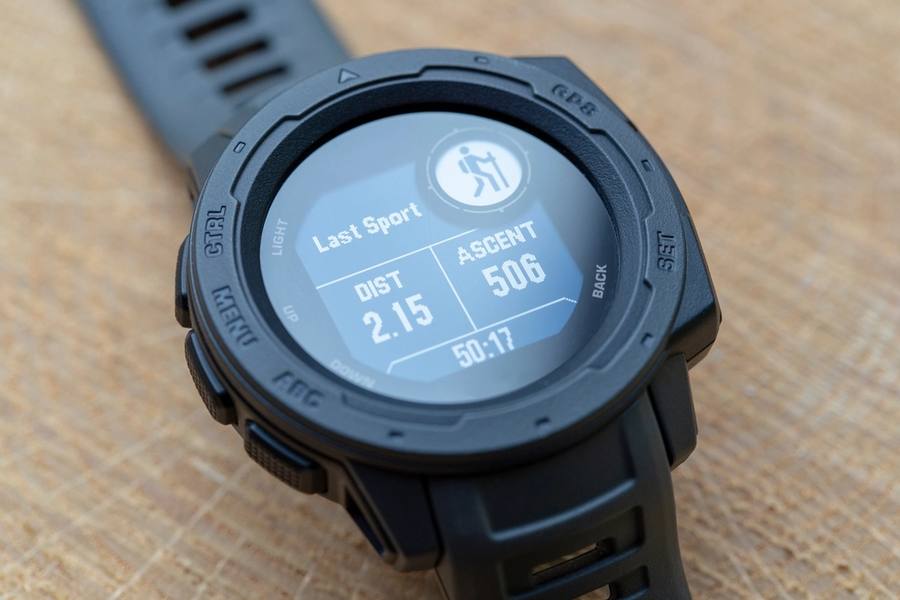
The case is fibre-reinforced polymer with a monochrome display, which is deliberately unglamorous and is why the battery lasts.
A colour touchscreen consumes far more power than a monochrome memory-in-pixel display, and Garmin chose the battery over the screen. The display is always on and readable in direct sunlight, which a bright colour screen often is not.
It is built to military-style durability standards with buttons rather than a touchscreen, which works with gloves and wet hands and never registers a phantom touch from a sleeve.
Navigation And Outdoor Function
It has multi-band satellite positioning, a compass, an altimeter and route navigation, which for hiking and trail use is genuinely functional rather than a headline feature.
Breadcrumb navigation back to a start point is the feature that matters most in practice, because getting lost is the actual risk and a watch that can retrace your route addresses it.
It is not a full mapping watch — there is no detailed map display — and route following and direction are handled well within the limits of a small monochrome screen.
Health Tracking And Practicalities
It tracks heart rate, sleep, stress and activity with Garmin's well-developed metrics, and the long battery life is what makes sleep tracking actually work since the watch is never off the wrist charging.
Smart notifications work and it is not trying to be a phone on your wrist. There is no meaningful app ecosystem and messages are read rather than replied to.
Solar charging needs genuine outdoor light exposure to contribute meaningfully. An office worker who is outside for twenty minutes daily will see modest benefit; a hiker will see a great deal.
Who It Suits
This suits somebody who is outdoors regularly, who wants reliable sleep tracking, and who is tired of charging a watch every night.
It suits less well anyone who wants a colour screen, app ecosystem or phone-like functionality, all of which this deliberately does not offer.
It suits particularly well multi-day trips and travel, where a watch that lasts weeks removes a charger from the bag and a worry from the itinerary.
The Verdict
The right priorities for an outdoor watch: weeks of battery extended by solar, a monochrome display readable in sunlight, buttons that work with gloves, and genuine navigation function.
The display is monochrome, there is no real app ecosystem, and solar only helps meaningfully with real outdoor exposure.
Battery life is the whole argument and it is a good one. A watch you do not charge nightly is a different kind of object from one you do.
En un coup d'œil
Avantages
- Weeks of battery life, extended further by solar
- Monochrome display always on and readable in direct sun
- Buttons work with gloves and wet hands
- Genuine navigation including breadcrumb return
Inconvénients
- Monochrome display only
- No meaningful app ecosystem
- Solar needs real outdoor exposure to help much
- No detailed mapping display
Questions fréquemment posées
Why does battery life matter so much?
Because a watch charged nightly cannot track sleep and is not on your wrist when you wake. One that runs for weeks is a watch rather than a gadget you wear, and that difference is fundamental rather than a specification improvement.
Is a monochrome screen a downgrade?
It is the trade that buys the battery life, and it has real advantages — always on, readable in direct sunlight where bright colour screens wash out, and no touchscreen phantom inputs from a sleeve.
Will solar actually help me?
Depends on your exposure. A hiker outdoors for hours sees a great deal of benefit; an office worker outside for twenty minutes a day sees modest benefit. It extends rather than replaces charging for most people.
Spécifications
| Type | Rugged outdoor smartwatch |
| Battery | Weeks; solar extended |
| Display | Monochrome memory in pixel, always on |
| Controls | Buttons, not touchscreen |
| Navigation | Multi-band satellite, compass, altimeter |
| Health | Heart rate, sleep, stress |
| Durability | Military-style standards |
| App ecosystem | Minimal |
Résumé
Weeks of battery, solar extended, readable in sunlight, buttons that work with gloves. Battery life is the argument and it is a strong one.
Vérifier le prix sur Amazon